Healthcare executives today are being inundated with buzzwords, such as generative AI, automation, predictive analytics, large language models – But a newer term is quickly taking center stage is Agentic AI.
The distinction matters. As health systems and revenue cycle organizations evaluate the next generation of intelligent automation, understanding what agentic AI truly is (and what it is not) becomes essential for safe adoption, risk management, and realizing its full value.
So, what exactly does agentic AI mean? And how does it differ from the automation and AI we’ve known so far?
Download our eBook: How Agentic AI is Transforming Healthcare Revenue Cycle Management
From Rules-Based Automation to Agentic Intelligence
In healthcare, traditional automation has long been rules-based – think of scripts or bots that follow explicit instructions:
“When X occurs, do Y.”
These tools are highly effective within narrow, repeatable processes: eligibility checks, claim status lookups, or batch posting. But they can’t adapt when data, workflows, or payer rules change.
Generative AI advanced that model by enabling systems to understand language, summarize documents, and create text. A chatbot can draft an appeal letter or explain a denial reason – but it can’t autonomously file that appeal, attach supporting evidence, or track the payer response.
That’s where agentic AI comes in.
Defining Agentic AI
As Forbes puts it, in healthcare contexts:
“Agentic AI refers to systems designed to operate semi-autonomously — to break down complex tasks, take multiple steps toward a goal, and adapt to changing information or rules.”
In other words, agentic AI doesn’t just analyze data, it acts on it. These systems are goal-driven, adaptive, and capable of learning from prior outcomes.
They don’t need detailed, step-by-step scripts. Instead, they’re given objectives, such as “resolve claim denials” or “complete prior authorization,” and they decide how to achieve those goals using a defined set of tools and permissions.
What Makes Agentic AI Different
Let’s break down the key differences:
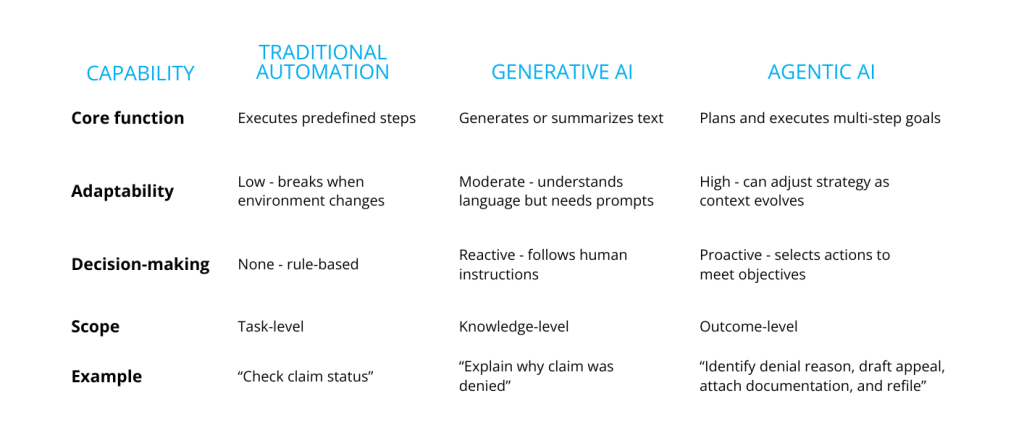
Agentic AI effectively merges the reasoning of large language models with the operational precision of automation – producing systems that can decide, act, and learn inside clinical and administrative workflows.
A Healthcare Example: Prior Authorization
Consider a practical use case: Matching clinical documentation to payer criteria for prior authorization.
- A rules-based bot might check whether an authorization exists for a scheduled procedure.
- A generative AI tool could summarize clinical documentation or suggest missing elements.
- An agentic AI system goes further, it:
- Reviews the clinical notes and payer policy.
- Determines if an authorization is required.
- Searches for an existing authorization number.
- If missing, prepares and submits the request.
- Tracks the payer portal for status updates.
- Updates the patient’s record once complete.
That’s not suggestion, it’s execution. The system operates semi-autonomously, with clear audit trails and escalation points for human approval where needed.
Inside the Engine: How Agentic AI Works
At ImagineSoftware, this approach is already being realized through ImagineCo-Pilot, a framework of AI agents designed to work within the complete revenue cycle management (RCM) platform, ImagineOne.
Here’s how these agents function differently:
- Goal-driven: They receive objectives (“resolve this denial”) rather than step-by-step scripts.
- Adaptive: If a payer portal changes or a required field moves, they can adjust their approach rather than fail.
- Collaborative: Multiple agents can work together – one retrieving data, another drafting a response, another submitting it – coordinated by an “orchestrator” agent.
- Transparent: Every action is logged and reviewable, maintaining compliance and traceability.
- Guardrailed: Agents operate within strict limits. Certain actions (like coding changes) remain off-limits and always require human review.
The result is a system that thinks through problems – like a co-pilot handling routine work while a human pilot oversees strategy and judgment calls.
Why Healthcare Needs This Step Forward
Healthcare operations, especially RCM, are filled with multi-step, data-intensive processes that require reasoning and judgment but are still repetitive and structured.
Tasks like denial management, payment reconciliation, credit balance resolution, or correspondence routing are prime candidates for agentic AI because they:
- Require reasoning across multiple data sources.
- Follow predictable regulatory or payer logic.
- Benefit from consistent, auditable actions.
- Consume enormous staff time with minimal strategic value.
Agentic AI bridges the gap, applying machine reasoning to take actions that used to require human intervention, while still preserving human oversight for complex, clinical, or ethical decisions.
Setting the Boundaries: What Should Remain Human-Led
Even with these advances, executives must define the line between automation and accountability.
A shared organizational definition should clarify:
- Autonomy: What decisions can an agent make independently?
- Scope: Which actions can it perform (For example: update claims, send appeals) versus those requiring user sign-off?
- Escalation: When and how should the system hand off to humans?
- Oversight: What audit trails, explainability tools, and dashboards ensure transparency?
This governance model is crucial for maintaining compliance with HIPAA, payer regulations, and internal quality standards.
Watch On Demand: Law & AI Order: Cybersecurity Unit
From safeguarding protected health information (PHI) to ensuring transparency and accountability in AI-driven processes, this session will help you stay ahead of the curve in an environment where compliance, trust, and innovation must work hand-in-hand.
The New Model: Human + Agent Collaboration
In the emerging healthcare operations model, humans define strategy and exceptions, while agents handle the execution.
Think of it as intelligent delegation:
- The AI agent executes complex, repetitive processes quickly and accurately.
- The human provides oversight, makes ethical or ambiguous decisions, and handles exceptions.
The Result: faster revenue cycles, lower costs, fewer manual errors, and a more strategic workforce.
The Bottom Line
Agentic AI isn’t just another AI buzzword, it’s a new operational paradigm.
Where traditional automation executes rules and generative AI creates insights, agentic AI delivers autonomous action, adaptation, and continuous learning inside your workflows.
It’s the bridge between intelligence and execution – between “knowing” and “doing.”
Healthcare leaders who define their agentic strategy early will be best positioned to capture efficiency gains, strengthen compliance, and reimagine how their teams work.
Ready to See Agentic AI in Action?
ImagineSoftware’s AI agents are already transforming revenue cycle operations, from prior authorizations and denials to post-payment review and credit balance resolution. Contact ImagineSoftware today to explore how agentic AI can be implemented in your medical practice or billing company.
Let’s build the roadmap for your next generation of intelligent automation.